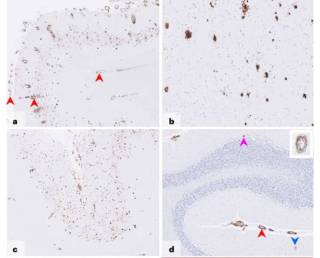
While the Unit is working to find alternatives to the use of laboratory animals in our research, at this time some crucial work can only be done in mice. Dr Emmanuel Asante and his team have developed a key series of animal models of human prion disease. This involves introducing various forms of the human prion protein gene into mice so that they produce human PrP. This includes both the M and the V form, and such mice are very sensitive to infection with CJD prions and have allowed us to study the various strains of human prions, including notably the strain (known as type 4) which causes variant CJD (vCJD). To date, all confirmed cases of vCJD have been associated with patients with two copies of the M form of the prion protein. To model vCJD, we have generated transgenic models with 2 copies of the M form of the human prion protein and challenged these with the bovine spongiform encephalopathy (BSE), commonly known as “mad cow disease” agent (prions), and we have been able to reproduce the characteristic features of variant CJD seen down the microscope (known as “florid plaques”) in these mice (Figure 1).
Figure 1. Modelling of vCJD in mice. The characteristic pathology of vCJD in human brain –abundant “florid plaques”- is demonstrated in transgenic mice expressing methionine-129 human PrP
Our studies have formed an important part of the evidence showing that variant CJD is the human counterpart of BSE. We also showed for the first time that BSE infection of the M genotype (genetic make up) can lead to an alternate phenotype (outward manifestation of the disease) that looks like sporadic CJD, in addition to the characteristic vCJD features.
Significant as these findings are, people with two copies of the M form of the prion protein constitute only about 38% of the Caucasian population. We have therefore extended our studies to investigate how people with the MV genotype (having one M and one V) who constitute about 51% of the population will be affected by BSE infection. We have reported that people with the MV genetic make up can also be infected by BSE prions, but the disease will present in a different form from what is known for vCJD so far. In particular, a well established hallmark of variant CJD is the presence of abundant florid plaques in brain sections (Figure 1) that are always linked with the detection of a form of the disease agent described as “type 4 PrPSc”, where PrPSc is the scientific designation for the rogue prion protein. However, our studies with the MV models show that the link between the characteristic brain pathology and type 4 disease agent seen in vCJD patients are no longer maintained.
The transgenic team led by Dr Emmanuel A Asante are also modeling inherited forms of prion disease that are associated with specific mutations (genetic changes) in the prion protein gene. Various genetic mutations are seen in patients with inherited forms of prion disease (also known as familial CJD and GSS). As well as investigating if all inherited forms of prion disease meet the criteria of prion diseases, the team’s modeling work is also aimed at confirming the prediction of the “protein only” hypothesis that inherited prion diseases can occur spontaneously (without any external factors other than having the faulty gene).
All these different types of animal models are been fully characterised and will allow us to test possible treatments for the human prion diseases when other studies ongoing within the Unit reveal suitable therapeutic drugs
Recent publications:
Absence of spontaneous disease and comparative prion susceptibility of transgenic mice expressing mutant human prion proteins.
Asante EA, Gowland I, Grimshaw A, Linehan JM, Smidak M, Houghton R, Osiguwa O, Tomlinson A, Joiner S, Brandner S, Wadsworth JDF, Collinge J.
J Gen Virol 90:546-58 (2009).
Hippocampal bursts caused by changes in NMDA receptor-dependent excitation in a mouse model of variant CJD.
Ratté S, Prescott SA, Collinge J, Jefferys JG.
Neurobiol Dis 32:96-104 (2008).
The origin of the prion agent of kuru: molecular and biological strain typing.
Wadsworth JD, Joiner S, Linehan JM, Asante EA, Brandner S, Collinge J.
Philos Trans R Soc Lond B Biol Sci 363:3747-53 (2008).
Kuru prions and sporadic Creutzfeldt-Jakob disease prions have equivalent transmission properties in transgenic and wild-type mice.
Wadsworth JD, Joiner S, Linehan JM, Desbruslais M, Fox K, Cooper S, Cronier S, Asante EA, Mead S, Brandner S, Hill AF, Collinge J.
Proc Natl Acad Sci U S A 105:3885-90 (2008).
Prion infectivity in variant Creutzfeldt-Jakob disease rectum.
Wadsworth JD, Joiner S, Fox K, Linehan JM, Desbruslais M, Brandner S, Asante EA, Collinge J.
Gut 56:90-4 (2007).
Dissociation of pathological and molecular phenotype of variant Creutzfeldt-Jakob disease in transgenic human prion protein 129 heterozygous mice.
Asante EA, Linehan JM, Gowland I, Joiner S, Fox K, Cooper S, Osiguwa O, Gorry M, Welch J, Houghton R, Desbruslais M, Brandner S, Wadsworth JD, Collinge J.
Proc Natl Acad Sci U S A 103:10759-64 (2006).
Phenotypic heterogeneity in inherited prion disease (P102L) is associated with differential propagation of protease-resistant wild-type and mutant prion protein.
Wadsworth JD, Joiner S, Linehan JM, Cooper S, Powell C, Mallinson G, Buckell J, Gowland I, Asante EA, Budka H, Brandner S, Collinge J.
Brain 129:1557-69 (2006).
Human prion protein with valine 129 prevents expression of variant CJD phenotype.
Wadsworth JD, Asante EA, Desbruslais M, Linehan JM, Joiner S, Gowland I, Welch J, Stone L, Lloyd SE, Hill AF, Brandner S, Collinge J.
Science 306:1793-6 (2004).
Pathogenic human prion protein rescues PrP null phenotype in transgenic mice.
Asante EA, Li YG, Gowland I, Jefferys JG, Collinge J.
Neurosci Lett 360:33-6 (2004).
BSE prions propagate as either variant CJD-like or sporadic CJD-like prion strains in transgenic mice expressing human prion protein.
Asante, E.A., Linehan, J.M, Desbruslais, M., Joiner, S., Gowland, I., Wood, A.L., Welch, J., Hill, A.F., Lloyd, S.E., Wadsworth, J.D.F. and Collinge, J.
EMBO J. 21:6358-6366 (2002).
Post-natal knockout of prion protein alters hippocampal CA1 properties, but does not result in neurodegeneration.
Mallucci, G.R. , Ratte, S., Asante, E.A., Linehan, J., Gowland, I., Jefferys, J.G.R. and Collinge, J.
EMBO J. 21:202-210 (2002).